Buying a car
What Is a Fleet Vehicle? What Used-Car Buyers Should Check
Fleet history describes prior use, not condition. Check the vehicle’s role, service records, modifications, equipment and inspection before judging the full deal.
Published
Sources checked . How this guide is prepared.
START HERE
The short answer
A fleet vehicle is a car, truck or other vehicle managed as part of an organization’s group of vehicles. In used-car shopping, the label describes prior ownership or use, such as a company, government or rental fleet. It does not by itself tell you the car’s condition, maintenance quality, exact equipment or fair price.
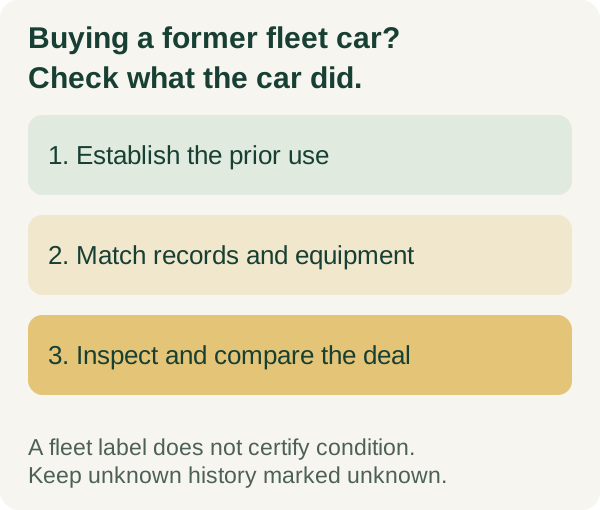
A former fleet vehicle can be a suitable purchase when its actual use, records, condition and complete costs meet your needs. Ask what work the car did and what evidence supports the answer before treating fleet as either a bargain badge or a reason to reject it.
Fleet vehicle does not mean rental car
Nissan’s fleet explanation describes vehicles grouped under business, nonprofit or government management. Fleet use can include different jobs and body styles. A passenger car assigned to an employee is a different proposition from a delivery vehicle or a former rental.
Do not assume every business vehicle belongs to the same kind of fleet, or that an organization’s fleet-program eligibility is a universal legal definition. This guide concerns buying a former fleet vehicle, not qualifying a business for a manufacturer discount, tax treatment or commercial registration.
If the actual use was rental, the former rental-car buying guide covers that narrower decision. Here, start by resolving which kind of fleet history you are being asked to accept.
Ask what the vehicle actually did
Request a factual description of the prior work: the organization type, the vehicle’s role, whether it had assigned or rotating drivers and the operating conditions the seller can document. Ask what is known rather than inviting a guess about how carefully everyone drove.
A high-mileage commuting car and a lower-mileage vehicle used for repeated short trips may have different inspection questions. Neither use pattern establishes condition on its own. Explain the available history to the inspecting shop and let it decide which checks are appropriate for the actual vehicle.
If engine-hour information is available and meaningful for that model, ask the shop to interpret it alongside the mileage and records. Do not convert hours to an invented universal mileage equivalent. If the history is unknown, record that uncertainty instead of assigning the car an attractive use story.
Match the service records to the actual car
Ask for available maintenance and repair records with VIN or other reliable vehicle identification, date, mileage and the work performed. Compare the records with the correct manufacturer maintenance requirements for the actual vehicle and use.
A company maintenance policy describes an intended process. It does not prove that a particular oil change, inspection or repair happened on schedule. Likewise, an incomplete record does not prove a component is bad; it leaves a question that may need clarification or assessment.
Useful follow-ups include who performed the work, whether a recommended repair was completed and whether the records cover the period the seller is describing. Request relevant redacted records where possible. You do not need employees’ personal addresses or unrelated company information to verify the car’s service evidence.
Verify the equipment instead of assuming a familiar trim
A fleet car can have equipment or modifications that differ from the retail example you remember. Confirm the actual engine, transmission, seats, safety features and installed options through manufacturer documentation and inspection.
If equipment was added or removed, ask for the work records and have the shop assess relevant areas. Former mounts, wiring changes, cargo partitions or other modifications should be evaluated professionally where applicable. Do not assume a clean appearance means every alteration has been properly addressed.
Use the make-and-model identification guide to keep year, trim and configuration separate. A familiar model name does not establish that the car has the same convenience or safety equipment as another example.
Use history information without treating it as a condition certificate
Obtain the available title and vehicle-history information, compare the identifiers and ask about discrepancies. A report may help frame questions about prior use or ownership, but missing information should not be converted into a confirmed personal-use history.
The vehicle-history report guide explains how to use title-history evidence and its limits alongside the car and its records. A fleet designation is a use description, not a declaration that every title, ownership, damage or condition question has been resolved.
The FTC’s used-car buying guidance recommends an independent inspection even when a car comes with a warranty or certification. Arrange access with the seller and agree with the shop on the inspection’s scope. Tell the shop about the known use and modifications before the appointment.
An original three-car evidence comparison
Imagine three advertised cars with the same 48,000 miles. Car A was assigned to a company employee and has identifiable service receipts. Car B carried deliveries, has partial records and has an unresolved equipment-removal question. Car C was a rental and has an available inspection report from the seller. These are invented examples, not CarTruvo inventory.
Do not rank them solely by the fleet category. For A, verify the receipts and current condition. For B, clarify the records and have the modification question assessed. For C, review the seller’s report and arrange the independent assessment you need; the label rental does not answer the condition question.
A useful comparison records three statuses for each issue: supported by evidence, unresolved or unacceptable for your needs. This prevents a persuasive ownership story from being treated as an inspection result. You may still prefer one use history, but make that preference visible after the factual questions are addressed.
Is a fleet vehicle cheaper to buy or insure?
There is no automatic discount in this guide. Compare actual asking prices and complete dealer quotes with similarly configured cars, accounting for mileage, condition, equipment and documented upcoming work. Obtain an insurance quote for the exact vehicle and your intended use.
Do not assume a fleet label guarantees cheaper insurance, financing or a higher resale value. If warranty, financing or insurance eligibility is important, disclose the relevant known history to the responsible provider and obtain its answer before relying on the benefit.
Use written estimates for work identified on the actual car. Do not subtract a made-up fleet penalty or add an assumed maintenance credit just because an organization once owned it. The complete deal needs to work with the evidence you actually have.
Download the former-fleet buying worksheet
The blank fleet-vehicle evidence worksheet contains sixteen prompts covering prior role, drivers, service records, modifications, exact configuration, history, inspection, costs and unresolved questions. It includes space to identify who will supply the missing evidence and the next follow-up date.
Choose a former fleet car when its documented condition, equipment and complete terms suit your use. Keep shopping when an essential question remains unanswered or a required provider will not support the arrangement. Fleet history should help you ask better questions, not decide the purchase for you.
Source check: November 19, 2026. The use-history comparison is an original hypothetical example. This guide does not report real fleet inspections, invent maintenance records or determine business tax or registration eligibility.
BEFORE YOU TAKE THE NEXT STEP
Practical checklist
Check the VIN, ownership record and seller details.
Arrange an independent inspection and review the written terms.
Confirm the total cost and title-transfer process before paying.
CHECK THE DETAILS
Sources and further reading
Follow the source linked beside a claim for its context. For a transaction, confirm current requirements with the relevant agency, lender or provider.
- Nissan’s fleet explanationnissanusa.com
- FTC’s used-car buying guidanceconsumer.ftc.gov
YOUR NEXT READ