Inspections & condition
What Is a Lemon Car? Defects, Buybacks and Buying Checks
Separate a recurring defect, an open recall and a manufacturer-buyback title. Check repair records, disclosures, inspection and provider terms before buying.
Published
Sources checked . How this guide is prepared.
START HERE
The short answer
A lemon car is commonly understood as a vehicle with a serious, persistent defect. Whether a vehicle legally qualifies for a lemon-law remedy depends on the applicable law and facts. A troublesome car, an open recall and a title marked as a manufacturer buyback are different pieces of information, so check each separately.
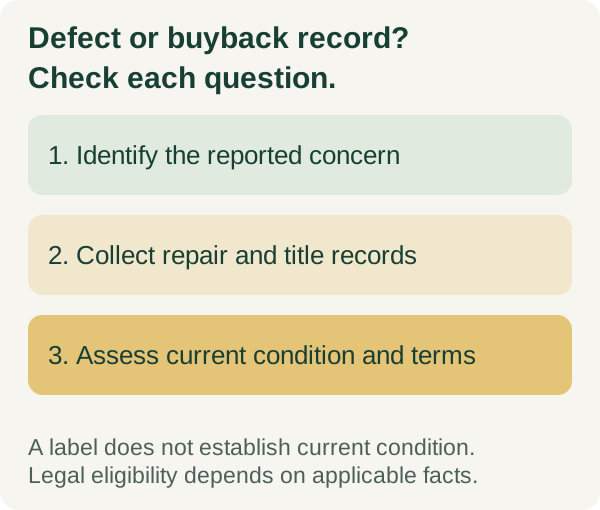
For a used-car buyer, the practical task is to understand the reported defect, obtain the repair and return records, verify the title history and assess the car’s current condition and purchase terms. The word lemon alone does not establish any of those facts.
A recurring problem is not automatically a legal finding
A defect that remains after repair visits deserves investigation, but this guide cannot decide whether a particular car qualifies for replacement or repurchase. Relevant rules can depend on location, transaction, warranty and the actual history. There is no universal nationwide repair-count shortcut in this guide.
As a specific US example, the California Attorney General’s car guidance describes covered defects that substantially impair use, value or safety and cannot be repaired after a reasonable number of attempts. It also explains that what is reasonable depends on several factors and directs consumers to qualified legal help for their circumstances.
Do not apply that summary as another state’s rule or assume every used vehicle is eligible on the same basis as a new one. If you need a legal remedy, consult the responsible state consumer-protection resources or a qualified attorney promptly. Preserve the documents needed to assess the actual case.
Lemon-law buyback is a title-history question
A manufacturer buyback record describes an earlier event. It is different from your own opinion that a car drives badly today. Equally, a car without that brand has not thereby been certified free from defects.
California DMV’s buyback guidance explains its Lemon Law Buyback title and registration branding for applicable manufacturer reacquisitions. Its procedures also address written disclosure of the reported nonconformities and attempted repairs to subsequent buyers.
That is a California example, not a promise that every jurisdiction uses identical wording or documents. Ask the relevant title agency about the actual record and requirements. Obtain the seller’s available return, disclosure and repair documentation instead of relying on a photograph of one side of a title.
An open recall answers a different question
A safety recall concerns a specific safety defect or compliance issue and the remedy process for affected vehicles. It is not, by itself, a decision that your car qualifies for a lemon-law buyback or a report of every past mechanical problem.
Check the actual VIN through NHTSA’s recall lookup and the manufacturer where appropriate. The lookup has coverage and reporting limits; no open recall result is a clean-condition certificate. Ask for evidence of completion when a relevant remedy is represented as done.
Keep recall information, warranty-claim history and title branding in separate entries. They can all matter to the same purchase, but one should not silently replace the others.
Request the records behind the defect description
Ask the seller what led to the return or concern and what documentation is available. Match the vehicle identifiers, dates, mileage, complaint descriptions and recorded work. A repair invoice shows a recorded job; it does not by itself prove that an intermittent issue cannot recur.
- Identify the original reported concern and any later recurring symptoms.
- Obtain available repair orders and the work recorded for each visit.
- Request manufacturer return or repurchase documentation if a buyback is claimed.
- Read the applicable title-history and seller disclosure information.
- Ask what current warranty or other protection is actually confirmed for the next buyer.
- Arrange an independent condition assessment that addresses the known concern.
Request relevant records with unrelated personal information redacted where practical. If key documents are unavailable, record the uncertainty rather than replacing them with a reassuring story about the prior owner.
A hypothetical two-car comparison
Imagine Car A has three repair orders for a recurring water leak but no buyback documentation has been provided. Car B has a disclosed manufacturer-buyback history and records describing repairs to its original reported issue. These are invented examples, not actual listings or diagnoses.
A’s missing buyback record does not prove there is no significant problem. B’s completed repair records do not automatically establish present condition. For each car, identify what is documented, what remains unresolved and what an appropriately qualified inspector can investigate.
You may decide that any buyback history is outside your preferences. Or you may investigate further if the documented history, current condition and complete terms could meet your needs. Neither approach requires claiming that every buyback is irreparable or every unbranded car is sound.
Have the current condition assessed before buying
Tell the independent shop about the known defect and ask whether its planned inspection can address that concern. An ordinary general inspection may not reproduce an intermittent problem or include specialist testing. Agree on scope and limitations before relying on the result.
The pre-purchase inspection guide helps organize that discussion. The vehicle-history report guide explains how title-history evidence fits alongside records and inspection. Neither process promises that every past fault will be found.
If a warning or symptom suggests the car may be unsafe, stop the test drive and arrange qualified assessment or safe transport as appropriate. Do not conduct risky maneuvers or keep driving to gather evidence for a claim.
Check financing, insurance and coverage for the actual car
Disclose the relevant known title and return history when requesting provider decisions. Obtain insurance and financing terms for the actual VIN if those are necessary to complete the purchase. Do not assume another buyer’s approval or a general quote applies to a branded vehicle.
Ask who is responsible for any promised repair coverage, what conditions apply and whether the known issue is included. The powertrain warranty guide explains why a covered-parts headline is only part of that check.
Compare the complete purchase and ownership terms with acceptable alternatives. A lower asking price is not a confirmed saving if material condition, eligibility or repair questions remain open. This guide provides no universal buyback discount or future resale prediction.
Download the lemon-car evidence worksheet
Use the blank defect and buyback buying worksheet to record sixteen defect, repair, return, title, inspection and provider checks. Keep legal eligibility questions separate from current-condition findings so neither becomes an unsupported conclusion.
If you already own the car, maintain a dated repair and communication record and seek the appropriate state-specific help. If you are still deciding whether to buy, obtain the evidence that matters before committing. The useful outcome is a clear view of the actual vehicle and unresolved questions, not a label applied from a distance.
Source check: November 19, 2026. California examples are identified as such. This guide is not a legal finding, repair diagnosis or report of vehicles personally inspected by CarTruvo.
BEFORE YOU TAKE THE NEXT STEP
Practical checklist
Check the VIN, ownership record and seller details.
Arrange an independent inspection and review the written terms.
Confirm the total cost and title-transfer process before paying.
CHECK THE DETAILS
Sources and further reading
Follow the source linked beside a claim for its context. For a transaction, confirm current requirements with the relevant agency, lender or provider.
- California Attorney General’s car guidanceoag.ca.gov
- California DMV’s buyback guidancedmv.ca.gov
- NHTSA’s recall lookupnhtsa.gov
YOUR NEXT READ
Keep reading