Buying a car
Zero-Percent Interest Car Loans: Compare the Full Deal
Compare zero-percent car loans with rebate and financing alternatives. Check eligibility, full price, term and total payments using clear hypothetical examples.
Published
Sources checked . How this guide is prepared.
START HERE
The short answer
A genuine 0% APR car loan can let an eligible buyer repay the amount financed without interest, but the rate alone does not establish the cheapest car purchase. Vehicle price, rebates, required term, cash contribution and fees still matter. Compare complete written offers for the same vehicle before choosing the zero-percent option.
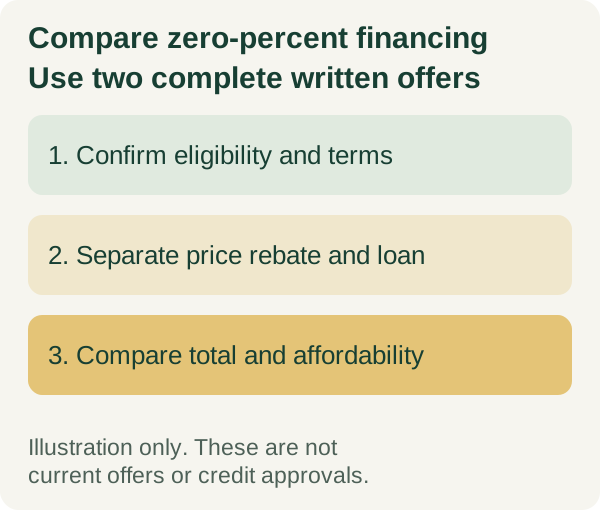
The practical question is: “What will I pay to acquire this car under each offer, and can I meet the payment schedule?” A deal with no interest can still be less attractive than another eligible offer with a lower purchase price and some interest.
Who qualifies for zero-percent car financing?
The CFPB’s guide to advertised 0% financing says these offers generally favor buyers with the highest credit scores and may require repayment over a relatively short period. The actual lender and program determine eligibility. There is no universal score in this guide that guarantees the advertised terms.
Ask which vehicles, model years, locations and buyers qualify, which lender supplies the financing and when the offer expires. Confirm whether the rate applies to the entire term and whether a particular down payment or maximum financed amount is involved. A general prequalification for credit is not proof of approval for the promotional program.
Use the car-buying credit-score guide to prepare for the application. Avoid paying for a supposed shortcut that promises to deliver a particular approval or score increase by a guaranteed date.
Where can you check current offers?
Start with the manufacturer’s official offers page and the participating dealer’s written terms for your ZIP code and VIN. For example, Toyota’s APR offers page describes special financing and qualification conditions, with links to vehicle offers. Special APR does not necessarily mean 0%, and a national page does not confirm local availability for your car.
Save the actual disclosure and its date. Ask whether the seller can provide the qualifying vehicle at the quoted total price. Do not assume a search-result headline or expired screenshot establishes a current offer.
This guide does not provide an unverified list of vehicles available at 0% today. Its examples below are invented to compare the economics. Your purchase decision should use the current offer, exact vehicle and final approval that you can document.
Zero interest is different from zero down
Zero interest describes borrowing cost under the stated terms. Zero down describes a cash requirement. A promotion can involve one, both or neither. Ask separately about the amount due at purchase and the complete repayment schedule.
The FTC’s advice on deceptive car ads warns that attractive financing headlines can come with qualification conditions, substantial cash requirements or other terms that change the deal. Check the written contract rather than relying on the largest type in an advertisement.
A deferred first payment is another separate term. Ask whether interest accrues before payments begin and whether it changes the final obligation. Do not assume “no payments for a period” means no interest during that period, or that a loan will remain interest-free if its actual terms describe something else.
Request two complete offers
If you are comparing promotional financing with a rebate and another loan, request an itemized purchase total for each route. Establish whether the rebate and promotional APR can be combined. Do not assume either that they always stack or that they are always mutually exclusive.
Record these fields for each eligible offer:
- Same VIN and agreed vehicle price before the financing choice.
- Applicable discount or rebate and its qualification conditions.
- Taxes, required charges and individually priced optional products.
- Cash contribution, trade equity and any old-loan shortfall.
- Amount financed, actual APR, term and payment count.
- Payment amount, finance charge and total payments.
- Upfront charges and any conditions that remain before funding.
The financing basics guide explains how the purchase ledger connects to the loan. Keep your trade negotiation visible so a change in the trade allowance does not disappear inside an apparently better rate.
Example: a rebate beats the zero-percent loan
Assume the same car can be acquired under two hypothetical offers. To isolate the choice, all taxes and required acquisition charges are included in the stated amounts, there is no cash down or trade, and neither loan has additional fees.
Offer A finances $30,000 at 0% for 60 months. The payment is $500 and total loan payments are $30,000. Offer B applies a $3,000 rebate, finances $27,000 at a fixed 3% annual interest rate with monthly amortization for 60 months, and has an APR equal to that rate under these no-fee assumptions.
Offer B’s payment is about $485.15. Using unrounded payment arithmetic, total payments are about $29,109.28, including about $2,109.28 in interest. Despite paying interest, the modeled rebate offer costs about $890.72 less than Offer A.
These are invented terms, not available dealer offers or current lender rates. They assume the buyer qualifies for both and the rebate is unavailable with Offer A. Different prices, taxes, fees, rates or eligibility can reverse the result.
Example: the zero-percent loan wins
Keep Offer A unchanged, but assume the $27,000 rebate route instead carries a fixed 6% annual interest rate for 60 months, again with no additional loan fees. Its payment would be about $521.99 and total payments about $31,319.14.
Under those assumptions, the zero-percent offer costs about $1,319.14 less. The rebate itself did not change; the cost of financing the lower purchase amount did. That is why “take the rebate” and “always take zero percent” are both incomplete decision rules.
Calculate with the actual offer and your intended repayment plan. If you expect to pay early, compare the payments made and the dated payoff at that earlier point. Do not assume a full-term interest figure is the cost you will necessarily incur under an early-payoff plan.
Can a zero-percent payment still be unaffordable?
Yes. Repaying $30,000 at 0% over 36 months requires about $833.33 per month, compared with $500 over 60 months. Those invented terms both avoid interest, but they create very different monthly obligations. A promotion limited to the shorter term cannot be evaluated using a longer term you have not been offered.
Include an actual insurance quote, fuel or charging, maintenance, registration and a repair reserve in your transportation budget. Preserve the cash needed for the down payment and irregular expenses. Approval is not proof that the agreement fits your household budget.
A lower-priced used car may deserve comparison even if its loan carries interest. Compare actual condition, acquisition cost, financing and ownership costs over the same period. Do not buy a more expensive vehicle solely because its financing percentage is lower.
Confirm the final contract
The CFPB’s APR explanation distinguishes the interest rate from the broader cost measure. Check the actual APR and finance charge, not only a statement that a component of the deal is interest-free.
Confirm that the purchase price, selected rebate, cash contribution, amount financed, rate and payment schedule match the route you chose. If an optional product appears, ask for its individual price and decide whether you want it. Obtain the final documents and make sure the financing conditions are resolved before treating the transaction as complete.
Use a promotional-financing comparison sheet
Download the zero-percent financing comparison worksheet. Complete one copy for the promotional route and another for the alternative, using the same vehicle and comparison period.
Ask the dealer: “Please provide the complete purchase and financing terms with the promotional APR, and the complete terms with any alternative rebate.” Compare the resulting totals and payment obligations before choosing the headline rate.
BEFORE YOU TAKE THE NEXT STEP
Practical checklist
Check the VIN, ownership record and seller details.
Arrange an independent inspection and review the written terms.
Confirm the total cost and title-transfer process before paying.
CHECK THE DETAILS
Sources and further reading
Follow the source linked beside a claim for its context. For a transaction, confirm current requirements with the relevant agency, lender or provider.
- CFPB’s guide to advertised 0% financingconsumerfinance.gov
- Toyota’s APR offers pagetoyota.com
- FTC’s advice on deceptive car adsconsumer.ftc.gov
- CFPB’s APR explanationconsumerfinance.gov
YOUR NEXT READ