Buying a car
When Is the Best Time to Buy a Car? Compare the Deal and the Wait
Compare seasonal buying windows with your budget, current offer and cost of waiting. Includes new-versus-used timing and a blank buying-readiness worksheet.
Published
Sources checked . How this guide is prepared.
START HERE
The short answer
The best time to buy a car is when you need it, can afford the full deal and have enough evidence to choose the actual vehicle. If your schedule is flexible, year-end and outgoing-model-year offers are useful new-car shopping windows. Used-car timing also depends on local availability and the condition of individual cars.
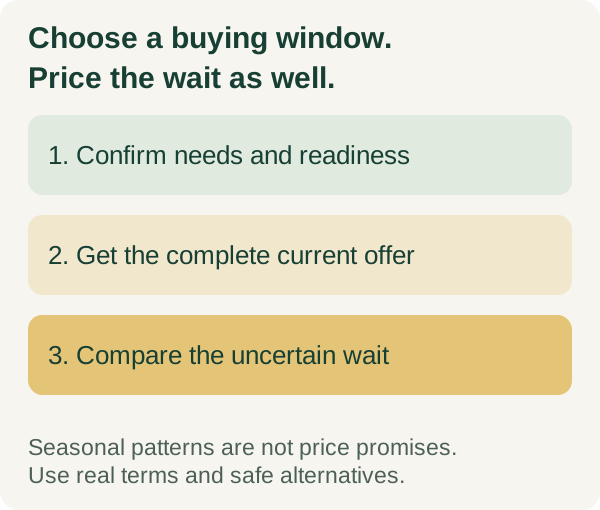
A calendar window is a reason to compare offers, not proof of a discount. Start with your readiness and the cost of waiting, then test any seasonal opportunity against written terms for a car you would actually buy.
What month is best for buying a new car?
In its October 19, 2026 new-car timing analysis, Edmunds describes December as a historically favorable month for discounts and highlights outgoing model-year inventory. Its evidence does not promise that every vehicle, trim or region will follow that pattern.
As of this guide’s November 19 source check, December 2026 has not happened. Treat later-year discount expectations as forecasts, not completed sales results. A desirable model in limited supply may not have the offer you want even when another vehicle is heavily promoted.
If considering an outgoing model year, compare the actual equipment and total price with the newer version. A lower asking price is useful only if the older configuration meets your needs. Check warranty start and coverage information with the responsible provider rather than inferring it from the model year alone.
Is the best time different for used cars?
Yes. A used car is an individual item with its own mileage, history and condition. A new-car manufacturer promotion does not automatically apply to it. In its July 7, 2026 used-car timing analysis, Edmunds identifies October and November as favorable seasonal shopping months in its data. That is a broad pattern, not a valuation for a particular listing.
Do not reject an otherwise sound, fairly priced used car solely because it appears in a different month. Equally, do not accept unresolved damage or missing ownership information because an advertisement calls a November price a sale. Compare similar configurations, mileage and condition, and leave time for an independent inspection.
The FTC’s used-car buying guidance recommends asking dealers for written out-the-door prices and obtaining an independent inspection. Those checks make the timing decision more concrete: you need to know both what the car costs and what you are being asked to buy.
Does the end of the month guarantee a better deal?
No. A date does not establish the seller’s willingness to lower a price or your eligibility for a promotion. Ask for a complete offer and its expiration rather than relying on a story about a salesperson needing one more sale.
Likewise, choose an appointment when you can inspect the car and understand the paperwork. If a weekday is quieter or more convenient, that can help you complete the process carefully; it does not guarantee a lower transaction price. Check the actual availability of the inspecting shop, lender and any required transfer service before arranging a holiday purchase.
If the seller says an offer ends tonight, request the terms in writing. A genuine deadline still does not make an unaffordable loan or an unresolved vehicle problem a good deal. Missing information remains missing at the end of a month.
Calculate the cost of waiting before chasing a discount
Use this original, hypothetical example. You hope the car you want will cost $1,000 less in two months. Waiting would require $250 per month in temporary transport, plus $300 in necessary expense to keep your current transportation safely usable during the wait.
- Temporary transport: two months multiplied by $250 equals $500.
- Additional necessary expense during the wait: $300.
- Modeled waiting cost: $500 plus $300 equals $800.
- If the hoped-for $1,000 price reduction happens, the modeled advantage is only $200.
If the future reduction is instead $500, the same $800 waiting cost leaves you $300 worse off in this limited scenario. If no reduction happens, the hoped-for saving never materializes. These are invented possibilities, not price forecasts or repair quotes.
This is a partial incremental-cost comparison. Include only costs caused by waiting and avoid counting the same expense twice. A full loan payment is not automatically an incremental expense because part can reduce principal. A fuller comparison may also need financing costs, depreciation, insurance, sale proceeds and ownership costs avoided by waiting. Ask an appropriate professional if those make your calculation unclear.
Do not postpone a necessary safety repair just to preserve this arithmetic. If your present transportation is unsafe, stop using it and arrange a safe alternative; the relevant comparison starts with options you can actually use safely.
Make a buy-now versus wait record
Write down the current VIN-specific out-the-door offer, its expiration and the conditions you can meet. For the wait option, record a range of possible future prices rather than treating the best case as known. Then record unavoidable incremental transport and other waiting costs over the same period.
Use this decision rule: wait when you can safely wait, have a workable transport plan and judge the potential benefit worth the uncertainty. Buy when the current vehicle and full terms meet your needs and the cost or risk of waiting is not justified. Keep shopping if neither option clears your budget or evidence requirements.
This approach does not require predicting the entire car market. It makes your own deadline, costs and uncertainty visible. Set a date to reassess the record instead of refreshing sale advertisements without a stopping point.
Check financing and incentives before choosing a shopping day
Separate vehicle price from the loan and any trade-in. Ask which discounts require manufacturer financing, particular eligibility or a trade, and whether offers can be combined. Obtain a complete quote for each option you can actually qualify for.
The zero-percent interest guide explains why an advertised rate and a cash-rebate alternative need a full-cost comparison. The car financing guide explains amount financed, APR, term and repayment. A calendar discount can be outweighed by a different financing structure.
Use the MSRP guide to distinguish the manufacturer’s reference price from the full purchase total. If you have a trade-in, use the separate best time to trade in a car guide for payoff, equity and replacement decisions. A generous-looking trade allowance does not establish that the combined purchase is cheaper.
A readiness checklist before committing
- Identify the actual vehicle, configuration and price rather than a starting-price advertisement.
- Get a written complete quote with included charges, eligibility conditions and expiration.
- Confirm the financing and down payment you can sustain, including ongoing ownership costs.
- For a used car, resolve material history and condition questions and arrange an independent inspection.
- Check that the seller and relevant service providers can complete the required steps on your planned date.
- Keep enough time to read the final documents and resolve differences from the offer.
If one item is unresolved, ask for the missing evidence before treating the shopping day as a deadline. A strong buying window still needs a suitable vehicle and an acceptable final agreement.
Download the car-buying timing worksheet
Use the blank buying-window and waiting-cost worksheet to record sixteen items, including the current offer, potential wait period, transport plan, uncertain future price, financing and inspection readiness. Its purpose is to turn a seasonal suggestion into a decision you can explain and revisit.
Start comparing before you are under pressure to replace the car. When a workable offer appears, compare it with the real alternatives available to you now. The best purchase date is the one supported by your needs, evidence and complete costs, with seasonal information serving as one input.
Source check: November 19, 2026. Seasonal observations are attributed to the dated analyses above. The waiting-cost example is original and hypothetical; this guide does not guarantee future prices, availability or financing approval.
BEFORE YOU TAKE THE NEXT STEP
Practical checklist
Check the VIN, ownership record and seller details.
Arrange an independent inspection and review the written terms.
Confirm the total cost and title-transfer process before paying.
CHECK THE DETAILS
Sources and further reading
Follow the source linked beside a claim for its context. For a transaction, confirm current requirements with the relevant agency, lender or provider.
- new-car timing analysisedmunds.com
- used-car timing analysisedmunds.com
- FTC’s used-car buying guidanceconsumer.ftc.gov
YOUR NEXT READ