Buying a car
Do You Need Good Credit to Lease a Car? Check More Than the Score
Understand lease credit requirements without assuming a universal score cutoff. Check the actual offer, application stage and full transportation budget.
Published
Sources checked . How this guide is prepared.
START HERE
The short answer
Good credit can improve your chances of getting a car lease on favorable terms, but there is no universal minimum score that guarantees approval or rejection. The leasing company’s criteria, your credit history, finances and the specific offer matter. A score shown in a banking app is a useful starting point, not a lease approval.
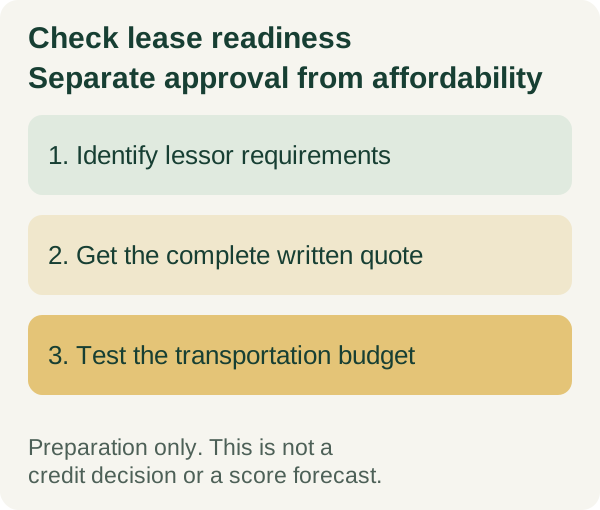
Before applying, separate three questions: could you qualify, do you qualify for the advertised deal, and can you afford the complete agreement? Those answers can differ. Get the requirements and a written quote for the actual car before deciding that approval alone makes it a workable choice.
What credit score is needed to lease a car?
Capital One’s leasing explainer says there is no universal credit-score requirement because criteria vary among lenders and dealerships. It also notes that a provider may use an auto-specific score rather than the score a shopper commonly checks.
Chase’s leasing guide suggests 700 or higher for a stronger chance of favorable terms while explaining that a lowest qualifying score is difficult to pinpoint. Treat that as shopping guidance, not a published approval floor that applies to every leasing company.
Ask the dealer which lessor would review the application, whether the advertised program has a specific credit tier and what other conditions apply. Avoid turning a national average or a salesperson’s general rule into an eligibility decision for your own application.
Why your app score may differ from the lessor’s score
The CFPB’s credit-score explanation describes multiple scoring formulas, products and reporting sources. A different number does not automatically mean either score is wrong.
Record the source and date of the score you checked. Review the underlying reports for unfamiliar accounts, incorrect late payments or other errors before assuming a score label explains everything. The FTC’s financing and leasing guide recommends checking your credit report before visiting the dealer.
If the provider uses a different score, ask which model and reporting source informed the offer. You do not need to reverse-engineer its scoring system to compare costs, but you should avoid judging your eligibility from a number the provider never used.
For a financed purchase instead of a lease, use the separate car-buying credit-score guide. Loan eligibility and lease eligibility should be confirmed for their respective products.
Can you lease with lower credit or little history?
It can be possible, but a particular provider may decline the application or offer different terms. Capital One describes potential outcomes such as fewer vehicle choices, higher upfront requirements or a higher lease factor. None is a promise that supplying more cash will secure approval.
Distinguish a limited credit file from a history containing missed payments. Ask which facts the lessor needs and whether it accepts the proposed applicant and vehicle. Provide accurate income, housing and existing-obligation information through the provider’s secure application process when you choose to apply.
Ask about a lower-priced vehicle, another eligible program or waiting while you address a documented issue. Compare the full outcome, including insurance and operating expenses. A used vehicle may be available under a separate program, as explained in used-car leasing, but its price alone does not prove easier approval.
Do not submit personal information to an unfamiliar seller simply because an advertisement says “everyone approved.” Identify the actual company, agreement and approval process first. A lease payment plan is a continuing obligation, not a substitute for checking affordability.
What changes between a headline offer and your quote?
An advertisement may depend on an eligible vehicle, location, credit tier, loyalty status or other conditions. Ask which apply to you and request the resulting written terms. If the dealer changes the payment, find out which part of the offer changed rather than accepting an unexplained monthly difference.
Keep these fields together:
- Vehicle VIN, lessor and program eligibility.
- Full amount due at signing and its components.
- Number and amount of payments, including taxes where applicable.
- Agreed vehicle value, rent charge or lease factor and applicable credits.
- Mileage allowance, return standards and end-of-term charges.
- Required insurance and maintenance responsibilities.
- Whether approval is final and what conditions remain.
A larger upfront payment can change the monthly quote without making the total cost attractive. Separate a refundable security deposit from a capitalized cost reduction and other charges. Ask what happens to each under the contract rather than treating every dollar at signing as interchangeable.
Check affordability separately from approval
Build a monthly transportation budget using your actual insurance quote and driving needs. Include the lease payment, fuel or charging, maintenance, registration costs and parking where relevant. Preserve room for irregular expenses instead of assuming the payment uses your entire available budget.
Consider a hypothetical shopper with $450 per month available for transportation. A $320 lease payment appears to fit. Add $140 for insurance and $100 for fuel and routine upkeep, and the modeled total becomes $560. That is $110 above the available budget before any omitted expenses.
The figures are invented, not a lease quote, local insurance estimate or recommended spending limit. They illustrate why a payment that passes an approval process can still fail your budget. If the agreement requires substantial cash at signing, evaluate that separately too.
For an actual lease-versus-purchase decision, use the lease-or-buy guide. Compare the same period and the position at the end rather than assuming the easiest approval or lowest payment produces the lowest complete cost.
Would a co-signer solve the problem?
Ask whether the lessor permits a co-signer and what the person would be agreeing to. The FTC explains that a co-signer assumes responsibility under the contract and that missed payments can affect both people’s credit. This is a financial obligation, not merely a reference or a way to borrow someone’s score.
A co-signer also does not resolve an unaffordable transportation budget. Have both people review the actual payment, term, end-of-lease obligations and any proposed release provision before signing. Do not promise that the lessor will remove the co-signer later unless that process has been confirmed.
Does leasing a car build credit?
Capital One says many leasing companies report payment activity to credit bureaus. Ask the actual provider whether and where it reports. Timely reported payments may help establish a positive history; missed payments can harm it. There is no guaranteed number of points or deadline for improvement.
Choose a vehicle agreement because it meets a transportation need at a manageable cost, rather than taking on an expensive lease solely to change a score. Keep account information current and make a payment plan that fits the agreement’s actual due dates.
Before submitting an application, ask whether the eligibility check creates a credit inquiry and whether you are authorizing a full application. Do not assume every online form described as a “check” is the same. If declined, request the provider’s explanation and read any notice it sends before repeatedly applying with the same unresolved facts.
Prepare a lease qualification record
Download the lease credit and affordability worksheet. It separates the score source, provider requirements, application stage, written offer and full transportation budget. Keep sensitive identifiers and actual credit reports in your own secure records, rather than putting them in a sheet you share with sellers.
Ask the dealer: “Which lessor and program are you quoting, which conditions apply, what does the complete lease cost, and is this an eligibility check or an application?” Use the answers to decide whether to apply, compare another option or address a specific issue first.
BEFORE YOU TAKE THE NEXT STEP
Practical checklist
Check the VIN, ownership record and seller details.
Arrange an independent inspection and review the written terms.
Confirm the total cost and title-transfer process before paying.
CHECK THE DETAILS
Sources and further reading
Follow the source linked beside a claim for its context. For a transaction, confirm current requirements with the relevant agency, lender or provider.
- Capital One’s leasing explainercapitalone.com
- Chase’s leasing guidechase.com
- CFPB’s credit-score explanationconsumerfinance.gov
- FTC’s financing and leasing guideconsumer.ftc.gov
YOUR NEXT READ