Buying a car
Can You Lease a Used Car? Programs, Costs and What to Check
Yes, some used cars can be leased. Compare current program examples, VIN eligibility, warranty, mileage and complete costs with a free worksheet.
Published
Sources checked . How this guide is prepared.
START HERE
The short answer
Yes, you can lease some used cars through programs that accept eligible pre-owned vehicles. Availability depends on the leasing company, dealer, exact vehicle and applicant. A used car advertised for sale is not automatically available to lease, and a certified label does not establish that a particular leasing program accepts it.
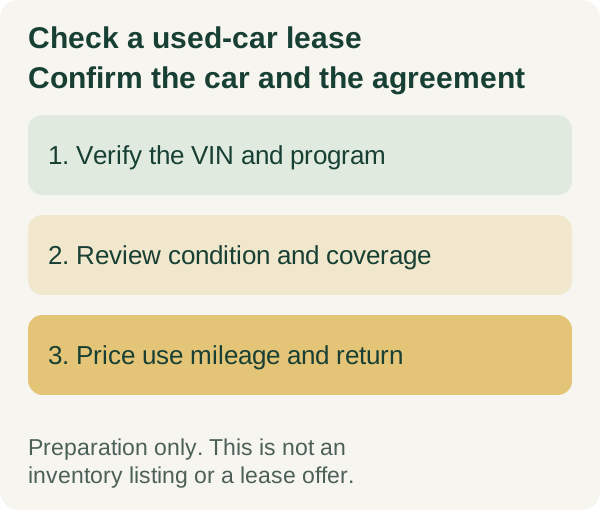
Start with the VIN and ask for a written lease quote. Then verify the program, mileage allowance, remaining warranty and complete cost. The useful comparison is between actual offers for the period you need the car, including what happens when that period ends.
Where can you lease a used car?
Manufacturer-backed certified programs are one place to investigate. Honda’s pre-owned leasing page, checked November 19, 2026, says leasing is available for HondaTrue Certified vehicles, including its Certified EV tier. It identifies eligible vehicles as up to six years old with fewer than 80,000 miles. It distinguishes those tiers from HondaTrue Used and ordinary Used vehicles, which the page says can be financed but are not available under that leasing program.
BMW Financial Services’ used-car leasing FAQ says BMW Certified vehicles qualify for leasing in most cases. That wording still calls for confirmation of the specific car and offer. It does not mean every used BMW on a dealer’s website can be leased.
These are current program examples, not recommendations of particular vehicles or promises of local inventory. Ask the participating dealer to name the lessor and confirm the VIN’s eligibility before you spend time comparing payments. Independent leasing companies may offer other arrangements; request their actual contract rather than importing a manufacturer program’s terms.
Used leasing, lease takeovers and rent-to-own are different
A new lease on a used car starts an agreement for that pre-owned vehicle. An approved lease assumption takes over an existing agreement, subject to the leasing company’s rules. Neither description tells you that you will own the car after making the scheduled payments.
The CFPB’s leasing explanation also describes Lease Here, Pay Here arrangements involving older used vehicles. It warns that payments may be frequent, rental charges high and repairs the driver’s responsibility. Such an agreement may have no purchase option. Do not treat a promise of easy approval as proof that payments build ownership.
Ask one direct question: “After the last scheduled payment, do I return the vehicle, own it, or have a separate option to buy it?” Have the seller identify the contract provision. If the answer involves another payment, record its amount or calculation, deadline and any conditions.
If your goal is to buy a car you already lease, use the separate lease buyout loan guide. That is a purchase and financing decision rather than shopping for a new used-car lease.
Confirm the car before comparing the payment
Request the VIN, model year, current odometer reading and complete condition report. Match the inspection or certification record to that vehicle. Ask which repairs or reconditioning were completed and whether you may arrange an independent inspection.
A certified vehicle can have a valuable inspection and warranty package, but it still needs evaluation for your use. Check tire condition, service history, missing equipment and expensive maintenance that may fall within your proposed lease period. The used-car inspection checklist helps organize those questions.
Record existing cosmetic damage before accepting delivery. Ask how it will be acknowledged in the lease records and distinguished from damage assessed when you return the car. Save dated photos and written condition notes rather than relying on a salesperson remembering the conversation years later.
Check the remaining warranty separately
Get the applicable warranty document, original coverage start date, mileage limits and any certified-program terms. Ask which coverage remains through your planned lease end. A car being new to you does not establish a new factory warranty clock.
Maintenance, tires, wear and damage can create expenses even when some warranty coverage remains. Ask who pays for each category and what happens if a major repair occurs after relevant coverage expires. The bumper-to-bumper warranty guide explains how a broad coverage label differs from approval of a particular repair.
For an EV, request the applicable battery coverage and available battery-condition evidence. Treat battery protection, the general vehicle warranty and the lease’s return standards as separate questions. Do not assume an advertised driving range proves the condition of this particular battery.
Read the entire used-car lease quote
The FTC’s financing and leasing guide explains that a lease pays for use, with depreciation, rent charges, taxes and fees, and that mileage, condition and early termination can matter. Apply that framework to the actual pre-owned offer.
Ask the dealer to fill in these details:
- Exact vehicle and lessor, plus the program or certification tier.
- Agreed vehicle value, lease length and number of payments.
- Total due at signing, showing whether it includes the first payment.
- Payment amount, included taxes and any separately billed charges.
- Starting odometer, permitted additional mileage and overage rate.
- Maintenance responsibilities, return-condition standards and disposition charges.
- Purchase option, its price or calculation, and associated fees.
- Early-exit terms and the procedure for any permitted lease transfer.
For a used car, clarify the mileage language carefully. An allowance of additional driving miles and an odometer ceiling at return are different ways to describe a limit. Ask which one the agreement uses and have the dealer work through your expected return odometer.
A hypothetical used-lease cost check
Assume a 24-month lease requires $1,500 at signing, including the first $280 payment, followed by 23 payments of $280. Assume a $300 disposition charge applies at a normal return. The scheduled cash outlay is $1,500 + $6,440 + $300 = $8,240.
Now assume the contract permits 20,000 additional miles over those two years, but your driving would add 24,000. At an invented overage rate of $0.25 per mile, 4,000 excess miles would add $1,000, bringing those modeled charges to $9,240.
These are invented terms, not a dealer quote or typical market price. The example excludes insurance, maintenance, repairs, extra wear charges and any taxes or fees not already included in the assumed amounts. Count the first payment only once. Ask for a quote that fits your expected mileage before deciding the low advertised payment is affordable.
Should you lease used or buy used?
Compare the same period and the actual cars. A returned lease leaves you without the vehicle, subject to the agreement’s final obligations. A purchase can leave you with a car and possibly a loan balance. A payment-only comparison leaves out those different end positions.
Use the existing lease-versus-buy comparison for that broader calculation. Keep this guide’s narrower questions attached: does the program accept the VIN, does its remaining coverage fit the lease period, and can you meet the condition and mileage terms?
For qualification questions, read whether you need good credit to lease. A used vehicle’s lower sale price does not establish easier lease approval or a lower complete lease cost.
Take a VIN-specific comparison sheet
Download the used-car lease comparison worksheet. Use one copy per vehicle to keep eligibility, condition, coverage, payment and return terms together.
Ask the dealer: “Is this VIN eligible for an actual used-car lease, who is the lessor, and can you provide the full quote and agreement?” If the answer only supplies a finance payment or a general program advertisement, the lease comparison is not ready yet.
BEFORE YOU TAKE THE NEXT STEP
Practical checklist
Check the VIN, ownership record and seller details.
Arrange an independent inspection and review the written terms.
Confirm the total cost and title-transfer process before paying.
CHECK THE DETAILS
Sources and further reading
Follow the source linked beside a claim for its context. For a transaction, confirm current requirements with the relevant agency, lender or provider.
- Honda’s pre-owned leasing pagehondacertified.com
- BMW Financial Services’ used-car leasing FAQfaq.bmwusa.com
- CFPB’s leasing explanationconsumerfinance.gov
- FTC’s financing and leasing guideconsumer.ftc.gov
YOUR NEXT READ