Buying a car
Gross Vehicle Weight: GVW, GVWR and What Your Car Can Carry
Separate actual gross vehicle weight from GVWR, curb weight and carrying limits. Use a hypothetical load calculation and blank worksheet to check the actual car.
Published
Sources checked . How this guide is prepared.
START HERE
The short answer
Gross vehicle weight, or GVW, is the vehicle’s actual weight with its current load. Gross vehicle weight rating, or GVWR, is the manufacturer’s maximum allowable loaded weight. They are different numbers: loading people or luggage changes GVW, but it does not increase GVWR.
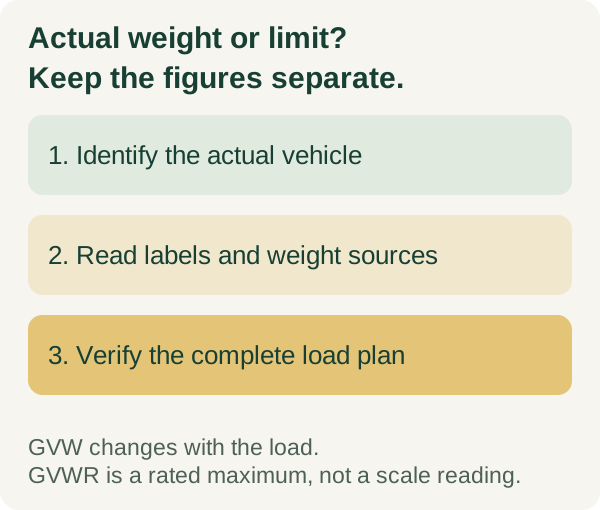
When buying a car, establish which weight a listing quotes, identify the actual vehicle’s labels and check whether it can carry your normal passengers and cargo within all applicable limits. A large cabin or empty luggage space does not establish the amount of weight you may add.
GVW versus GVWR: actual weight and a rated limit
Ford’s vehicle glossary distinguishes actual loaded vehicle weight from the maximum rating. It also points owners to the vehicle’s certification label and owner guide for the applicable GVWR.
A brochure or listing may show GVWR because it is a published specification. That does not mean the car currently weighs that amount. Conversely, an actual scale reading describes a particular loaded condition, not the maximum the manufacturer permits.
Record the label and source beside each number. If an advertisement simply says “gross weight,” ask whether the seller means actual weight, a maximum rating or something else. Resolve that ambiguity before using the figure in a load or transport decision.
Curb weight versus gross weight
Curb weight generally describes the vehicle prepared to operate, before occupants and cargo, under the source’s stated definition. Ford’s glossary includes standard equipment, operating fluids and a full fuel tank in its definition and notes that regulatory definitions may differ.
Do not add fuel twice when working from a figure that already includes it. Check whether the published figure represents the actual engine, drivetrain and fitted equipment. Accessories or modifications can also make a brochure’s base figure an unsuitable substitute for the car’s present weight.
Use the make-and-model identification guide to establish year, trim and configuration. An engine or drivetrain change within the same model family can matter when matching specifications. If actual weight is needed, arrange appropriate weighing in the relevant loaded condition rather than treating a general model average as a measurement.
Find the labels on the actual vehicle
Look for the manufacturer’s certification label and Tire and Loading Information label in the locations described by the owner manual. They answer different questions. The certification information identifies rated limits; the tire/loading information provides vehicle-specific loading guidance.
As a manufacturer example, Honda’s maximum-load guidance directs readers to the actual doorjamb label and includes occupants, cargo, accessories and applicable trailer tongue load in its loading discussion. The figure shown for that manual’s vehicle is not a universal allowance for other cars.
If a label is missing, unreadable or inconsistent with the vehicle, ask the manufacturer or an appropriately qualified professional how to establish the correct information. Do not fill the gap with a similar-looking car’s placard or create your own replacement limit.
A hypothetical loaded-weight calculation
Assume an identified vehicle, ready to load and with fuel already included, has a verified weight of 3,800 pounds. Assume its GVWR is 5,000 pounds. You plan to add 600 pounds of people, 350 pounds of luggage and 100 pounds of accessories not already included in the measured starting weight.
- Added weight: 600 plus 350 plus 100 equals 1,050 pounds.
- Planned total: 3,800 plus 1,050 equals 4,850 pounds.
- Difference below the assumed GVWR: 5,000 minus 4,850 equals 150 pounds.
This original example uses invented vehicle figures. It is not a load approval or a specification for a current model. It assumes the starting weight and every addition are correctly identified and counted once.
The 150-pound gross margin does not establish that axle, tire, occupant/cargo, towing or other applicable limits are satisfied. Distribution and the manufacturer’s instructions still matter. Verify the complete load plan for the actual vehicle; do not load to this example’s figures.
Payload and axle limits are separate checks
Payload describes carrying capacity under the applicable definition. For a buying decision, use the actual vehicle’s loading label and manual instead of deriving a final permission from a base curb-weight subtraction alone.
Gross axle weight rating, or GAWR, concerns a particular axle. Honda’s guidance specifically says not to exceed GVWR or GAWR. A total weight under the vehicle’s overall maximum does not, by itself, establish that each axle or another component remains within its limit.
Where a load plan is close to a limit or involves substantial accessories, ask a qualified professional to help verify actual weights, distribution and the relevant requirements. A simple arithmetic sheet is useful for organizing the evidence; it does not replace that assessment.
GVWR is not towing capacity
Do not subtract current GVW from GVWR and call the result an allowable trailer weight. Vehicle carrying limits, trailer ratings, hitch limits, tongue load and gross combination limits address different parts of a towing setup.
Read the actual model’s towing instructions and have an appropriately qualified towing professional resolve the combination where needed. Honda’s cited manual directs owners to its separate towing section rather than treating the gross-weight figure as the entire towing decision.
The crossover-versus-SUV guide provides a checklist for checking the exact configuration, required equipment and capability evidence before buying for a towing or utility task. A hitch or a rugged vehicle description is not proof of the rating you need.
Use weight information when comparing two cars
Write down your usual people and cargo requirements before the viewing. Ask the seller for the actual labels and confirm fitted equipment and modifications. Compare the same task in both cars, leaving unresolved questions marked as unresolved.
For the physical-fit check, use the sedan-versus-SUV guide. A stroller fitting through the opening and a family fitting comfortably in the seats are useful results, but neither establishes loading capacity. You need both practical space and the applicable weight allowance.
Ask the inspecting shop to assess relevant modifications or condition concerns as part of an agreed pre-purchase inspection. An inspection does not change the manufacturer’s ratings. Do not assume suspension or tire changes automatically authorize a higher vehicle limit.
Download the vehicle weight evidence worksheet
Use the blank GVW and GVWR buying worksheet to record sixteen identification, source, measurement, loading and unresolved-question checks. Keep actual weights, manufacturer ratings and assumptions in separate entries so one cannot quietly become another.
Before choosing a car for a demanding load, you should be able to explain which figures apply to the actual configuration and how the complete loading plan has been checked. If the required evidence is missing, obtain it before relying on the vehicle’s advertised capability.
Source check: November 19, 2026. This guide explains terminology and a buying workflow. Its arithmetic is hypothetical and does not certify a vehicle, towing setup or legal operating limit.
BEFORE YOU TAKE THE NEXT STEP
Practical checklist
Check the VIN, ownership record and seller details.
Arrange an independent inspection and review the written terms.
Confirm the total cost and title-transfer process before paying.
CHECK THE DETAILS
Sources and further reading
Follow the source linked beside a claim for its context. For a transaction, confirm current requirements with the relevant agency, lender or provider.
- Ford’s vehicle glossaryford.com
- Honda’s maximum-load guidancetechinfo.honda.com
YOUR NEXT READ